Les terrasses de Sakura Garden
Click on the images to enlarge them / Cliquez sur les images pour les agrandir
We had to face facts: the house and garden at La Pompignane, the Guiraud family’s home for over 80 years, were beginning to weigh heavily on our shoulders. It was time to sell, move on and settle into a flat that was easier to maintain. The garden, in particular, had become a burden for me. The wide variety of plants meant we needed individual drippers, which, because of limescale, had to be unblocked every year using a needle. It took a week to get the watering system up and running again every spring. It was simply no longer manageable for the two of us!
So, at the end of July 2025, we moved into a rooftop flat, with two huge terraces and three balconies, covering 200 m² on the 4th and 5th floors of the building.
Il fallait bien se rendre à l’évidence : la maison et le jardin de la Pompignane, fief de la famille Guiraud depuis plus de 80 ans commençaient à peser lourd sur nos épaules. Il était temps de vendre, partir et s’installer dans un appartement plus facile d’entretien. Le jardin en particulier, était devenu un fardeau pour moi. La multiplicité des végétaux exigeait des goutteurs individuels qu’il fallait déboucher tous les ans avec une petite aiguille, à cause du calcaire. Cela prenait une semaine pour remettre l’arrosage en état de marche au printemps. Cela n’était plus possible pour nous deux !
Donc, nous sommes arrivés fin juillet 2025 dans un appartement « Roof Top », comme on dit, avec deux immenses terrasses et trois balcons au 4ème et 5èmeétages sur 200 m2.
.
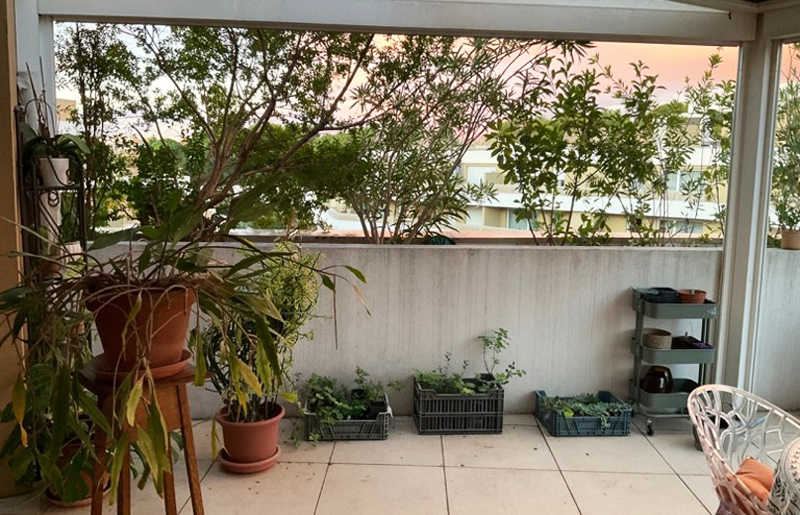
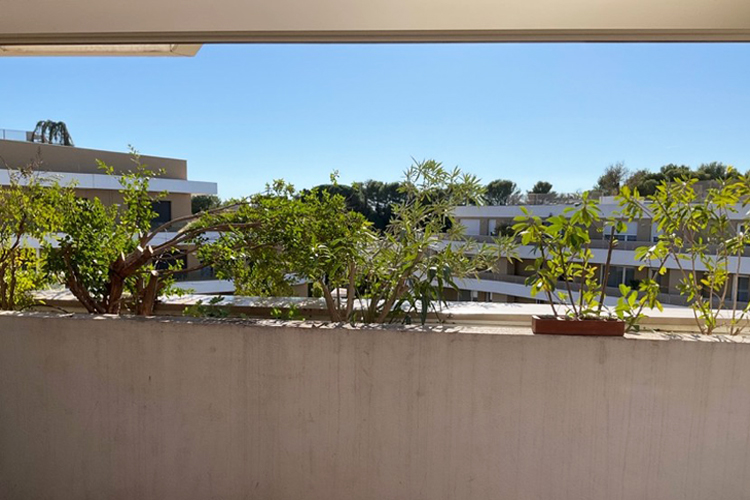
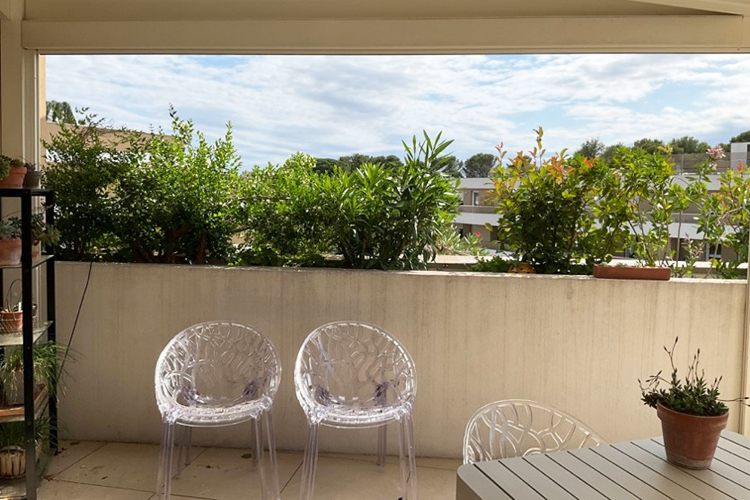
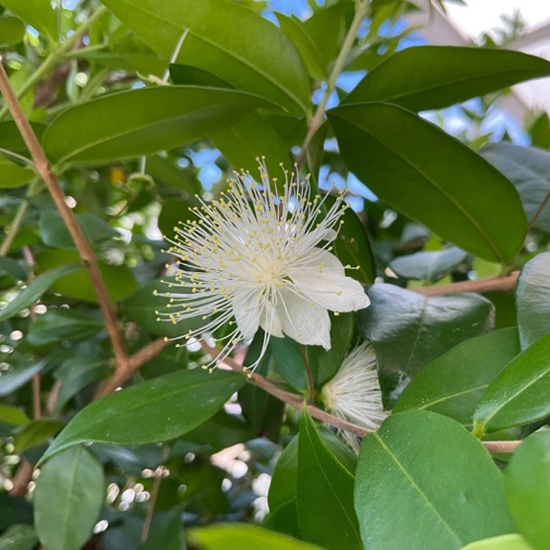
I was delighted to be able to garden at eye level again, as both terraces are fitted with planters running around the edges. On the 4th floor, the planter was already stocked with mediterranean plants: Nandina domestica, Myrtus communis, Nerium oleander, Photinia fraseri, Melaleuca sp.and Viburnum tinus. On the 5th floor, all the plants had disappeared, apart from a cycas in poor condition, a magnificent nandina and a few phormiums.
J’étais ravie de refaire du jardinage à hauteur d’homme, car les deux terrasses sont pourvues de jardinières situées sur le pourtour. Au 4ème, la jardinière était déjà fournie en végétaux méditerranéens : Nandina domestica, Myrtus communis, Nerium oleander, Photinia fraseri, Melaleuca sp.et Viburnum tinus. Au 5ème tout avait disparu et il ne restait qu’un pauvre cycas, un magnifique nandina et quelques phormiums.
.
.
For over a year, I had been preparing cuttings taken from my garden in La Pompignane. All this tiny vegetation waited patiently throughout the summer until October, when it was time to plant.
Depuis plus d’un an, j’avais préparé plusieurs boutures prises dans mon jardin de la Pompignane et tout ce petit monde a attendu bien sagement tout l’été jusqu’en octobre afin d’être planté.
I began drawing up plans to work out where the new additions would be planted. The site faces due south, so both terraces get plenty of sun. However, shade-loving plants could be put in at the base of existing ones. As the low wall supporting the planter was white, it was essential to introduce trailing plants to break up the feeling of enclosure. Additionally, the existing shrubs needed pruning, as they had not been well maintained by the previous owner and, as a result, some were poorly formed and spindly. They were no longer fulfilling their role as a screen against the surrounding blocks of flats. That’s when you start asking yourself – when to prune, exactly where on the plant, and so on. I decided that October was a good time.
J’ai commencé à faire des plans pour savoir à quel endroit les nouveaux venus allaient être plantés. L’exposition est plein sud, donc très ensoleillée sur les deux terrasses. Mais je pouvais planter les végétaux préférant l’ombre au pied des végétaux déjà existants. Le muret contenant la jardinière étant de couleur blanche, il fallait à tout prix installer des plantes retombantes afin de casser cette impression d’enfermement. D’autre part il a fallu tailler les arbustes existants, car ils n’avaient pas été entretenus par le propriétaire précédent et donc, certains étaient rachitiques et dégingandés. Ils ne remplissaient plus leur fonction d’écran vis-à-vis des immeubles environnants. C’est à ce moment-là que l’on se pose des questions : quand faut-il tailler, à quel endroit du végétal, etc. Je me suis dit qu’octobre était tout de même un bon moment.
I removed the dead branches – in fact, that’s all I did to the nandinas, as they were well-proportioned. I find that nandina is a very hardy plant, resistant to cold, heat and, especially, drought. I pruned the myrtles a little, not knowing whether there would be re-growth and I must say they tolerate pruning very well. They’ve produced plenty of fruit, but, unfortunately, there’s still a major drawback. When the ripe fruit falls on the ground, you need to sweep it up quickly, because if you walk on the fruit the patio ends up covered in stains that are difficult to remove, unless a high-pressure washer is used.
J’ai enlevé les branches mortes, c’est d’ailleurs tout ce que j’ai fait sur les nandinas, car ils étaient bien proportionnés. J’en conclurait que le nandina est vraiment une plante très résistante, au froid, à la chaleur et surtout à la sécheresse. J’ai un peu taillé les myrtes, ne sachant pas s’ils allaient refaire des branches et je peux vous dire qu’ils supportent très bien la taille. Ils ont donné beaucoup de fruits, mais, malheureusement c’est tout de même un inconvénient majeur. Quand les fruits murs tombent par terre, on a intérêt à vite balayer, car si l’on marche dessus, la terrasse se retrouve maculée de taches difficiles à enlever, à part avec un nettoyeur à haute pression.
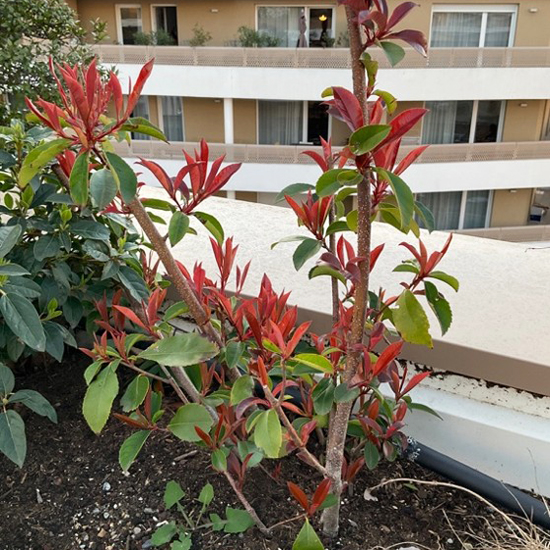
The oleanders were in poor condition, with lots of brown leaves. I pruned them back heavily, cutting some branches to 10 cm above the ground. I’ll need to prune them again this autumn. Oleanders are prone to aphids, so I’ve set up ant traps, as ants are drawn to aphids for the honeydew. However, on the fifth plant, I see still more aphids, so as I’ve spotted some ladybirds, I’m going to let them do the job! The photinias were not pruned very much as they were looking a bit unhappy. I don’t know why the leaves would start to shrivel as soon as they emerged in early spring. These are plants which get off to a very early start in the spring season.
Les lauriers-roses étaient mal en point avec beaucoup de feuilles brunies. Je les ai bien taillés, certaines branches à 10 cm du sol. Il me faudra encore retailler cet automne. Ces plantes sont sujettes aux pucerons et j’ai donc installé des pièges à fourmi, car ce sont elles qui les élèvent pour le miellat. Par contre au 5ème, les pucerons sont toujours là et comme j’ai vu des coccinelles, j’attends qu’elles fassent le travail ! Les photinias n’ont pas été trop taillés car ils étaient un peu malingres. Je ne sais pas pourquoi les feuilles se rabougrissent une fois qu’elles sont sorties dès le début du printemps. Ces plantes démarrent très tôt en saison.
.
.
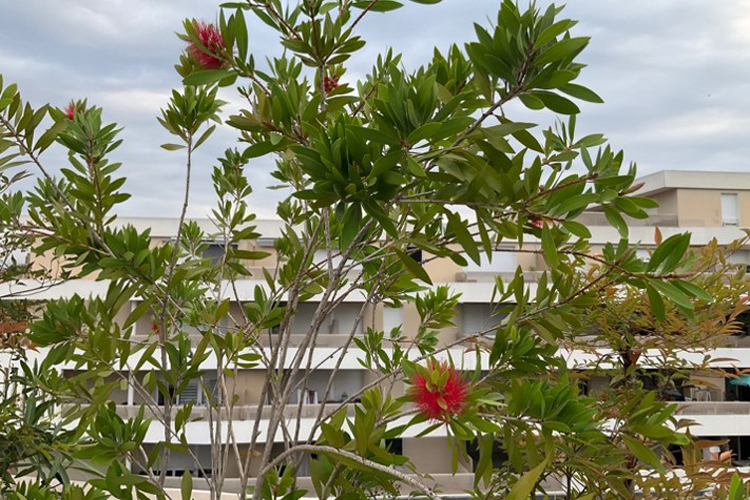
I didn’t prune the melaleucas (formerly callistemon) too much, as I wasn’t sure how to go about it, but, as it turned out, the plants have formed good new growth below the pruning cut. I don’t know the species name, but now, in August, they are flowering for the second time this summer. The plant isn’t very bushy, so it doesn’t really hide the property opposite, but the flowers are so beautiful and exotic that you can overlook that. As for the Viburnum tinus, it’s struggling to get going again. It may be suffering from being planted too close to a photinia.
Je n’ai pas trop taillé les melaleucas (anciennement callistemon), ne sachant pas comment m’y prendre, mais, finalement, ces végétaux reforment bien des branches sous les tailles. Je ne connais pas le nom de l’espèce, mais actuellement, en aout, ils refleurissent pour la deuxième fois de l’été. La plante n’est pas très fournie et donc elle ne cache pas beaucoup le vis-à-vis, mais cette floraison est tellement belle et exotique qu’on peut lui pardonner. Le Viburnum tinus, lui, a du mal à redémarrer. Il souffre peut-être de la promiscuité avec un photinia.
.
.
I should, of course, mention that I’ve added huge amounts of compost, mixed with a potting soil for Mediterranean plants. I added fertiliser, plus a layer of mulch made from shredded bark, to minimise evaporation. Speaking of fertiliser, I carried out a comparison: on the 4th floor, I used fertiliser pellets designed for Mediterranean plants, and on the 5th floor, I used my long-standing favourite mixture: dried blood and crushed horn. Guess the winner: the dried blood and crushed horn mixture. The plant on the 5th floor has tripled in size compared to the same one on the 4th. Of course, we have had to set up an automatic watering system that dispenses water via individual drippers at night (3 minutes, 6 times a day).
Il faut bien sur vous dire que j’ai ajouté des tonnes et des tonnes de terre végétale mélangée à du terreau pour plantes méditerranéennes. J’y ai ajouté de l’engrais plus une couche de mulch composé d’écorces broyées afin de limiter l’évaporation. A propos d’engrais, j’ai fait une comparaison : au 4ème j’ai mis de l’engrais en billes type plantes méditerranéennes et au 5ème j’ai mis mon mélange favori depuis des années : sang séché plus corne broyée. Devinez le gagnant : mélange sang séché + corne broyée. Le même végétal au 5ème a triplé en taille par rapport à celui du 4ème. Bien sûr nous avons installé un arrosage automatique qui diffuse par goutteur individuel de l’eau la nuit (3 minutes six fois par 24h).
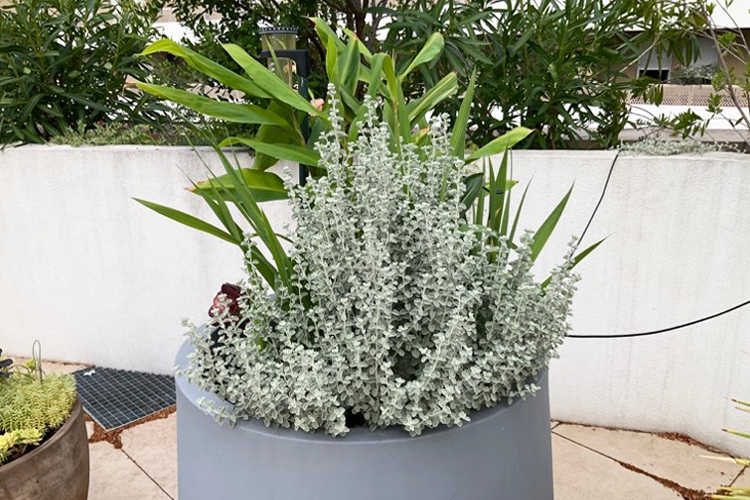
On the 4th floor terrace – the floor where we live (the 5th being reserved for guest bedrooms) – there were three enormous planters containing a weeping cedar, a cycas infested with scale insects and an ailing strelitzia. I got rid of the cycas and the weeping cedar, and I will see how the strelitzia fares – it nearly died this winter. I’ve never actually seen it in bloom, not last summer nor this summer. I’ve added a hedychium which hasn’t flowered yet, a few gladiolus bulbs, and a magnificent Leucophyllum zygophyllum ‘Cimarron’, bought in the spring, which is so happy here that it has tripled in size since then. It even flowered in May–June with its tiny purple flowers, set off beautifully by its grey foliage.
Il y avait sur cette terrasse du 4ème étage, qui est en fait notre niveau de vie (le 5ème étant réservé aux chambres d’amis) trois immenses potées proposant un cèdre pleureur, un cycas farci de cochenilles et un strelitzia souffreteux. Je me suis débarrassée du Cycas et du cèdre pleureur et je laisse sa chance au Strelitzia qui a bien failli mourir cet hiver. D’ailleurs, je ne l’ai jamais vu en fleur, ni l’été dernier ni cet été. J’y ai ajouté un Hedychium (pas encore fleuri), quelques bulbes de glaïeul, et un magnifique arbuste Leucophyllum zygophyllum ‘Cimarron‘acheté au printemps et qui se plait tellement qu’il a triplé en taille depuis. Il a même fleuri en mai-juin de ses petites fleurs violettes mises en valeur par son feuillage gris.
.
.
To go with these three containers, I bought six weathered terracotta pots of different sizes. In them I planted a superb purple aeonium, a Pelargonium graveolens, a Cestrum nocturnum and an Agave attenuate: all of them died during the winter. I was tempted to give the agave a go, even though I knew full well that it is by no means hardy. Last winter was very cold – certainly colder than the winter of 2025. Castelnau is frequently one degree colder than Montpellier, and I had grown these plants in pots in my old garden, tucked away on a patio sheltered from the wind and the cold. During January and February, my Castelnau terraces were battered by strong, cold winds; temperatures dipped to around -6°C at times, accompanied by constant rain. There is nothing worse than a recurring cycle of freezing temperatures and rain. The conclusion: perhaps wrap the pots in bubble wrap and place them near the wall of the building, under the pergola, to protect them from rain.
Pour accompagner ces trois potées, j’ai acheté 6 autres pots de taille différente en terre cuite vieillie. J’y avais planté un superbe aeonium pourpre, un Pelargonium graveolens, un Cestrum nocturnum et un Agave attenuata : tous ont péri lors de l’hiver. J’ai voulu tenter ma chance avec cet agave bien que je sache pertinemment qu’il n’est absolument pas rustique. L’hiver a été très froid en tout cas plus froid que l’hiver 2025, Castelnau présente parfois un degré de moins que Montpellier et ces trois dernières plantes étaient cultivées en pots dans mon ancien jardin à l’intérieur d’un patio abrité des vents et du froid. Lors des mois de janvier et février, mes terrasses ont été balayées par des vents violents et froids, les températures ont frisé -6°C par moments combinées avec des pluies constantes. Il n’y a pas pire que l’alternance du gel et de la pluie. La conclusion : peut-être protéger les potées extérieurement avec du papier bulle et évacuer ces potées contre la façade sous la pergola pour les protéger de la pluie.
You might be wondering what I did with all the cuttings I brought back from my old garden. Well, they were used to furnish the terrace on the 5th floor, which was practically empty, and to fill the gaps in the planting boxes on the 4th floor. I added some Erysimum ‘Bowles’s Mauve,’ Euryops pectinatus (the one with silvery foliage) and some lavenders.
Vous vous demandez peut-être mais qu’a-t ‘elle fait de toutes les boutures ramenées de son ancien jardin. Et bien elles ont servi à habiller la terrasse du 5ème étage qui était pratiquement vide et à boucher les trous dans la jardinière du 4ème. J’y ai ajouté des Erysimum ‘Bowles’s Mauve’, Euryops pectinatus, celui à feuillage argenté et des lavandes.
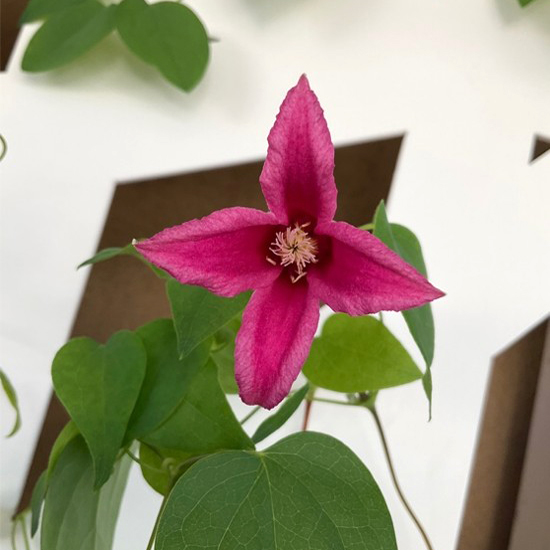
My favourite (re)discovery has been Clematis ‘Princess Diana’, which I had planted in the ground in the Pompignane garden, but had not flowered at all in five years. I put it in a pot, and it sent up 2-metre-tall stems in the spring, began flowering in bright pink in June–July and in August is embarking on a second flush of blooms. It is supposed to be very drought tolerant, being of Texan origin.
Ma plus belle (re)découverte : Ma clématite ‘Princess Diana’, planté en pleine terre dans le jardin de la Pompignane et n’ayant pas fleuri une seule fois en 5 ans. Je l’ai mise en pot et elle a lancé des tiges de 2 m de haut au printemps, s’est mise à fleurir d’un rose vif en juin-juillet et entame actuellement une deuxième vague de floraison. Elle est réputée s’adapter parfaitement à la sécheresse, et, en effet, c’est une texane.
.
.
A few gap-fillers that are looking good in August 2026:
Quelques plantes bouche-trous qui se portent très bien en août 2026 :
- Geranium macrorrhizum “Sandwijck”: flowered from mid-March to the end of May.
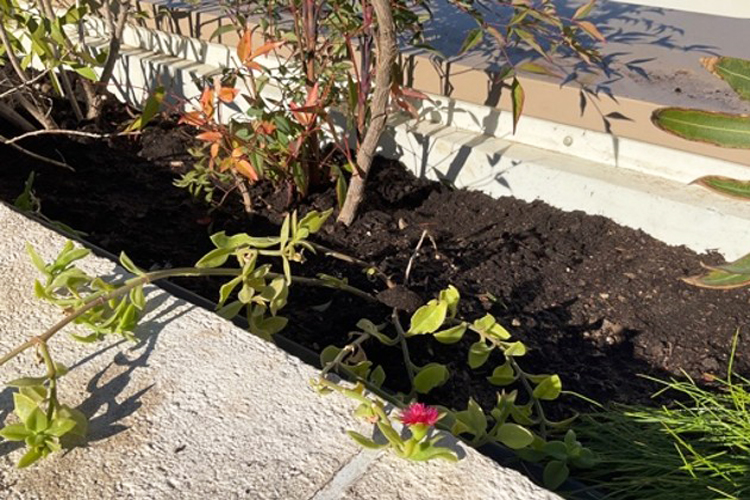
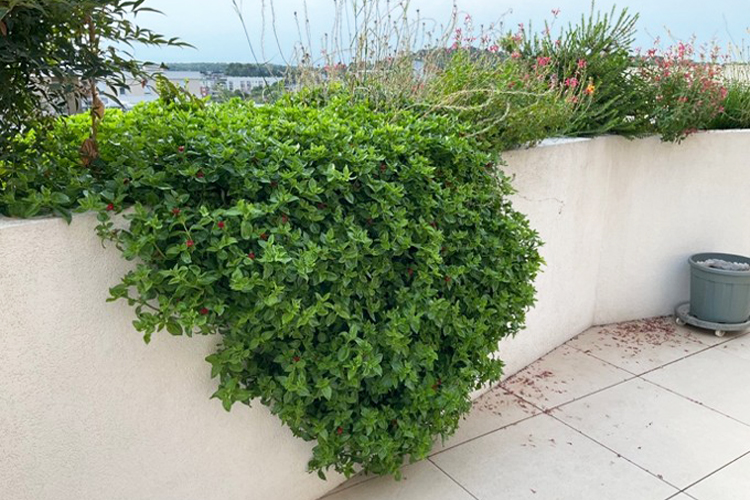
- Aptenia cordifolia: very long flowering period, nothing better for cascading over a low wall.
- Geranium macrorrhizum ‘Sandwijck‘, a fleuri de mi-mars à fin mai.
- Aptenia cordifolia : Il n’y a pas mieux pour retomber sur un muret avec une très longue floraison.
.
.
- Malephora crocea: only opens its stunning bright orange flowers in the sun.
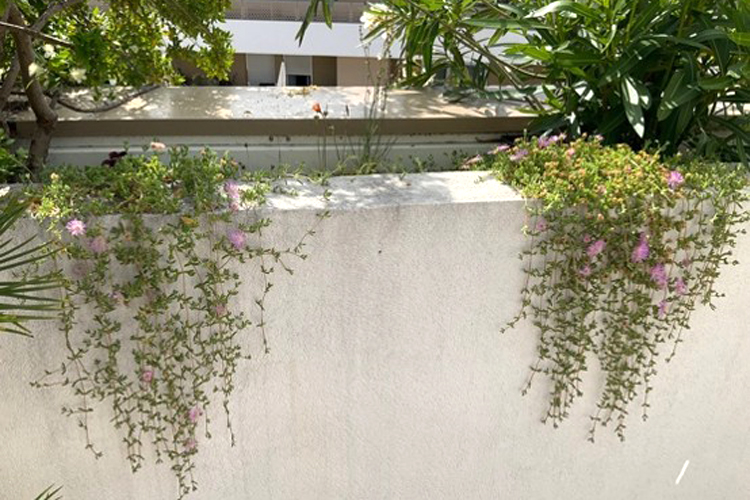
- Drosanthemum floribundum: does a good job of hiding the wall but is not as compact as aptenia and only flowers in May and June.
- Malephora crocea : n’ouvre ses superbes fleurs orange vif qu’au soleil.
- Drosanthemum floribundum : remplit bien son rôle pour cacher le muret mais n’est pas si compact que l’Aptenia et surtout ne fleurit qu’en mai-juin.
.
.
- Capparis spinosa ‘Inermis’: I wanted to give the caper bush a go because of its magnificent white flowers. It is doing well so far but isn’t growing quickly. Still too early to say, as it was only planted in spring.
- Bulbine frutescens ‘Hallmark’: thrives in full sun and has a long glowering period.
- Buxus balearica: growing slowly but is positioned in the shade.
- Allium schubertii: this bulb thrives in a container. The flower head is a good 30 cm in diameter!
- The tulbaghias are stunning. I recommend Tulbaghia cominsii and Tulbaghia violacea ‘Silver Lace’.
- Gazania rigens: has had orange flowers since May.
- Euryops pectinatus: was a bit damaged by aphids in the spring but is now doing fine and has doubled in size.
- Myrsine africana: I have high hopes for this, as it’s a great substitute for box, but it does grow extremely slowly.
- Erigeron karvinskianus: Everyone knows this little daisy that creeps everywhere and self-seeds profusely. It has been flowering non-stop since April.
- Salvia microphylla var. neurepia: a bit battered by this winter’s cold winds but now doing very well.
- Erysimum ‘Bowles’s Mauve’: What more could you ask for from a plant than for it to flower continuously for six months?
- Euphorbia characias: This is a self-seeded plant that I found in my old garden and carefully brought over here, because its foliage is variegated with white. It has flowered well and grown considerably, but its variegation is less pronounced than before.
- Tinantia pringlei: a magnificent ground-cover plant that deserves to be better known. Planted to hang over the low wall, its green foliage, tinged with purple, cascades down. It has just finished flowering, as it would prefer partial shade and cooler soil.
- Lavandula lanata: has not deigned to flower this year. I will give it time to adapt to its new location.
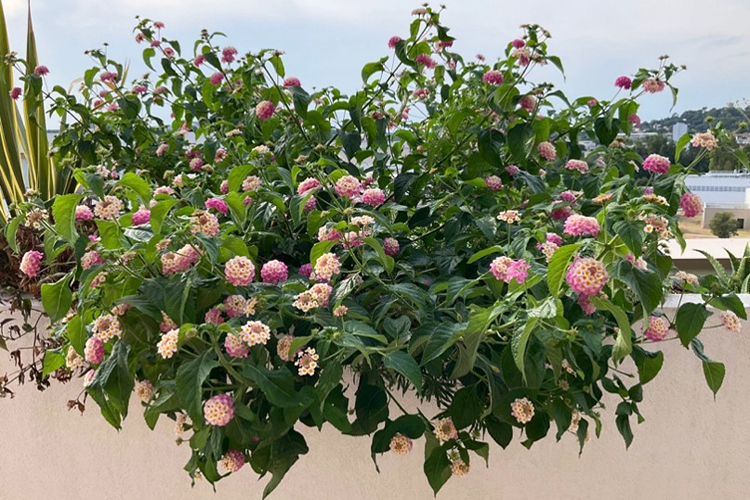
- Lantana sp.: the cultivar is two-toned, pink and orange, and is, of course, a reliable choice, however it does lose its leaves in winter.
- Capparis spinosa ‘Inermis’: J’ai voulu tenter ce câprier pour ses magnifiques fleurs blanches. Pour l’instant il va bien, mais ne pousse pas vite. Il est encore trop tôt pour se prononcer, car il a été planté au printemps seulement.
- Bulbine frutescens ‘Hallmark’ : se plait en plein soleil et fleurit longtemps.
- Buxus balearica : Il ne pousse pas vite mais se trouve à l’ombre.
- Allium schubertii : ce bulbe s’épanouit très bien en jardinière. La tête fleurie fait bien 30cm de diamètre !
- Les Tulbaghias sont superbes : je recommande Tulbaghia cominsii et Tulbaghia violacea ‘Silver Lace’.
- Gazania rigens : des fleurs orange depuis le mois de mai.
- Euryops pectinatus : un peu boulotté par les pucerons au printemps, mais maintenant tout va bien et du coup il a doublé en taille.
- Myrsine africana : j’ai beaucoup d’espoir en elle, car c’est une championne pour remplacer le buis, mais elle pousse vraiment lentement.
- Erigeron karvinskianus : Qui ne connait pas ce petit bout de marguerite qui s’insinue partout, se ressème à foison, et qui fleurit sans discontinuer depuis le mois d’avril ?
- Salvia microphylla var. neurepia : un peu rabattue par les vents froids de cet hiver, mais finalement s’en sort très bien.
- Erysimum ‘Bowles’s Mauve’ : Que peut-on demander de plus à une plante que de fleurir depuis 6 mois ?
- Euphorbia characias : C’est un semis naturel découvert dans mon ancien jardin et ramené précieusement ici, parce que son feuillage était panaché de blanc. Il a bien fleuri, a beaucoup grossi depuis mais sa panachure est moins prononcée qu’avant.
- Tinantia pringlei : C’est un magnifique couvre-sol, qui mériterait d’être plus connu. Installé en surplomb du muret, il dégringole avec son feuillage vert teinté de pourpre. Il vient de s’arrêter de fleurir car préfèrerait la mi-ombre et un sol plus frais.
- Lavandula lanata : elle n’a pas daigné fleurir cette année. Laissons-lui le temps de s’adapter à son nouvel emplacement.
- Lantana sp. : ce cultivar est bicolore rose-orange et bien entendu c’est une valeur sure bien que caduque.
.
.
- Lobelia laxiflora var. angustifolia: another safe bet. I like to pair it with bulbine.
- Ajania bellania ‘Bengo Weiss’: This little daisy with grey foliage is a beauty! It was given to me by our much-missed friend, Henri Nardy, 12 years ago and I keep it with me wherever I go. It is indestructible, grows quickly and if it starts to look a bit leggy, it simply needs to be cut right back and it springs back to life. What’s more, it brightens up our dull November and December days with its white flowers.
- Iberis semperflorens: lovely bright green foliage and a long flowering period from February to July.
- Talinum paniculatum: currently looking marvellous in a pot alongside Oxalis triangularis and a purple aeonium. It dies back in winter, so I’ll need to find it an evergreen companion.
- Lobelia laxiflora var. angustifolia : lui aussi est une valeur sure. J’aime beaucoup l’associer à la bulbine.
- Ajania bellania ‘Bengo Weiss’ : quelle beauté que cette petite marguerite à feuillage gris ! Elle m’a été donné par notre regretté Henri Nardy il y a 12 ans et je la traine partout. Elle est indestructible, pousse vite et si elle se trouve toute dégingandée, il suffit de la tailler à ras et elle reprend de plus belle. De plus elle nous égaye de ses fleurs blanches en novembre-décembre.
- Iberis semperflorens : beau feuillage vert franc et longue floraison de février à juillet.
- Talinum paniculatum : fait merveille en ce moment en pot en compagnie de l’Oxalis triangularis et de l’aeonium pourpre. Comme il disparait en hiver, il faut lui trouver une compagne persistante.
Have I mentioned sedums? No, not yet. These are plants that can withstand cold, drought and chilly winds. They are unrivalled when it comes to filling a pot and tumbling over the edges with such fluid grace. My favourite is Sedum x rubrotinctum, a gift from Bruno Pellier.
Est-ce que je vous ai parlé des sedums ? Non, pas encore. Ce sont des végétaux résistant au froid, à la sécheresse et aux vents froids. Ils n’ont pas leur pareil pour habiller une potée et dégringoler sur les bords avec tellement de légèreté. Mon chouchou c’est Sedum x rubrotinctum offert par Bruno Pellier.
.
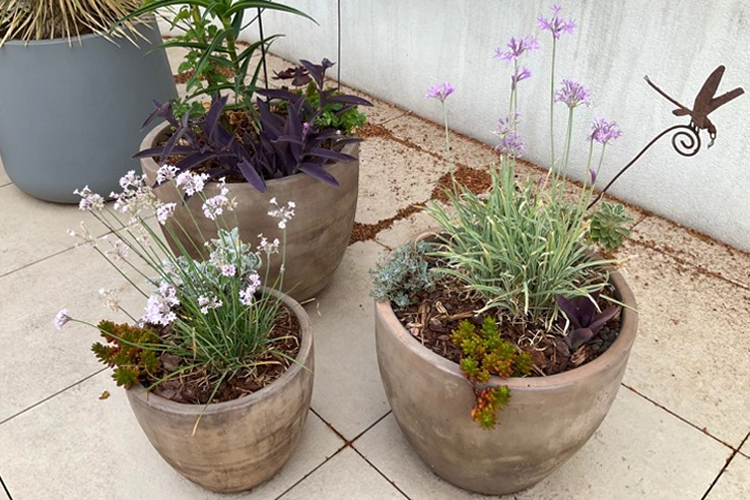
Front right pot / Potée devant droite : Tulbaghia ‘Silver Lace + Rhodanthemum hosmariense + Sedum x rubrotinctum
.
We must also talk about the disappointments, because, of course, there have been several.
Il faut bien parler des échecs aussi, car j’en ai eu bien sûr.
- Dichondra repens ‘Silver Falls’: How I love this pretty, silvery, silky ground-cover plant! But it refuses to cascade down the low wall, and its foliage is blown away by the slightest breeze. It will have to be replaced.
- Lathyrus odoratus: forget about trying to grow sweet peas here!
- Geranium cantabrigiense ‘Biokovo’ isn’t a complete failure, but it is currently hiding underground because it’s far too hot for it in its pot.
- Kalanchoe daigremontiana: The ones in pots died this winter, due to the cold wind and constant rain. However, a neighbour on the ground floor, where it is less exposed to the icy winds, has some very tall ones that didn’t suffer at all. I have taken a few cuttings and will try again next winter.
- Hybrid mandevilla: The entire top growth died back this winter. After sprouting again from the base in spring, it was once again wiped out by the heat and, no doubt, lack of frequent watering.
- Oxalis triangularis: It behaved in much the same way as the mandevilla, but started to flower again, rather late, from June onwards, with great difficulty.
- Phormium ‘Bronze Baby’: This one, in a pot, also succumbed to the heat and lack of regular watering.
- Haloragis erecta: I’ve been growing this small shrub for a very long time, ever since Joanna Millar gave me some seeds. It has bronze foliage that cannot tolerate frost, but it nevertheless survived in my 5th floor planter, flowered profusely, then faded away! I think it must have had too much sun and couldn’t withstand the heatwave, but I have plenty of seeds and hope to have new seedlings soon!
- Gladiolus undulatus: Another gift, this one from Australian gardener, Trevor Nottle. It used to flower valiantly every year in May but has become so shy that it didn’t show its face at all this spring. Is it still there?
- Lavandula dentata: found dead when I returned from holiday on 15 July. No explanation…
- Bulbine frutescens ‘Medicus’: all gone, in this case, no doubt about it, last winter’s frost and rain destroyed these bulbines.
- Dichondra repens ‘Silver Falls’ : comme j’aime ce joli couvre-sol argenté et soyeux ! Mais il ne veut pas dégringoler du muret et ses branches s’envolent au moindre souffle. Il faudra le remplacer.
- Lathyrus odoratus : il faut oublier les pois de senteurs chez nous !
- Geranium cantabrigiense ‘Biokovo’ n’est pas vraiment un échec mais il se cache sous terre en ce moment car il a beaucoup trop chaud en pot.
- Kalanchoe daigremontiana : en potées, ils ont tous péri cet hiver, à cause du vent froid et des pluies constantes. En effet une voisine du rez-de-chaussée, moins sujette aux vents glacials en possèdent de très hauts qui n’ont pas bronchés de tout l’hiver. J’ai récupéré quelques plantules et j’essaierai de nouveau l’hiver prochain.
- Mandevilla hybride : Toute la partie aérienne a disparue cet hiver. Après être reparti de la base au printemps, il est à nouveau anéanti par la chaleur et surement un manque d’arrosage constant.
- Oxalis triangularis : Il s’est comporté comme cette dernière, mais vient de refleurir un peu tardivement à partir du mois de juin et avec beaucoup de difficultés.
- Phormium ‘Bronze Baby’ : Lui aussi a succombé à la chaleur et au manque d’arrosages réguliers (en pot).
- Haloragis erecta : Je la cultive depuis bien longtemps, depuis que Joanna Millar m’a donné des graines. C’est un petit buisson au feuillage bronze qui ne supporte pas les gelées, mais qui a tout de même survécu dans ma jardinière au 5ème étage, a fleuri abondamment et s’est ensuite éclipsé ! A mon avis, elle avait trop de soleil et a succombé à cette canicule, mais j’ai un trop plein de graines et j’espère avoir des semis naturels bientôt !
- Gladiolus undulatus lui aussi est un cadeau d’un jardinier australien, Trevor Nottle, qui fleurissait vaillamment tous les ans au mois de mai. Il est devenu très timide au point de n’avoir pas pointé le bout de son nez au printemps. Est-il encore là ?
- Lavandula dentata : retrouvée morte à mon retour de vacances le 15 juillet ? aucune explication…
- Bulbine frutescens ‘Medicus‘ : tout a disparu et là pour sûr, gel + pluie de l’hiver dernier ont eu raison de ces bulbines.
All in all, I’m having a wonderful time on my terraces, and although there is much talk of global warming, I get the impression that there are no longer any set patterns. We cannot rely on past weather experiences, and above all, I cannot compare my new terraces to my old garden, which was, after all, surrounded by walls, with tall foliage providing good protection for the plants below.
Finalement, je m’amuse beaucoup sur mes terrasses, et bien qu’on parle sans arrêt de réchauffement climatique, j’ai l’impression qu’il n’y a plus de constantes. On ne peut pas compter sur le climat passé et surtout je ne peux pas comparer mes terrasses à mon ancien jardin qui était tout de même entouré de murs, avec de hautes frondaisons protégeant bien les plantations en dessous.
Here, on the 4th and 5th floors, the winds blow fiercely in both winter and summer, and the sweltering temperatures are intensified by the white walls. The heat gets trapped. It is a new challenge for me; I am having to learn about the complexity of the different climatic conditions.
Ici, au 4ème et 5èmeétages, les vents soufflent avec vigueur l’hiver et l’été, les températures caniculaires sont renforcées par les murets blancs. La chaleur est prise au piège. C’est un nouveau challenge pour moi, j’apprends la multiplicité des climats.
Texte et photos : Chantal Guiraud
