Heteropterys glabra
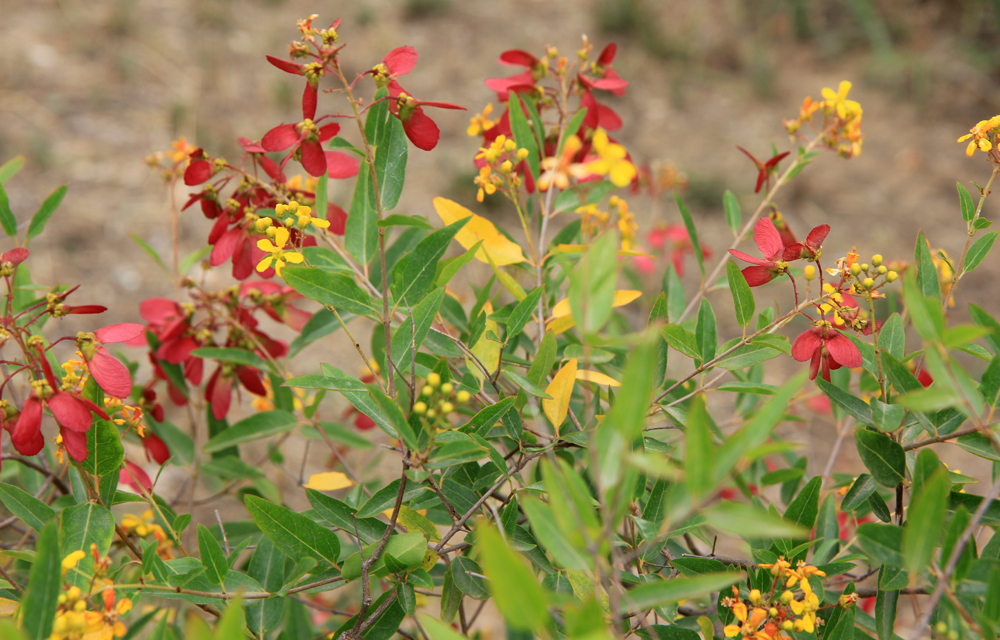
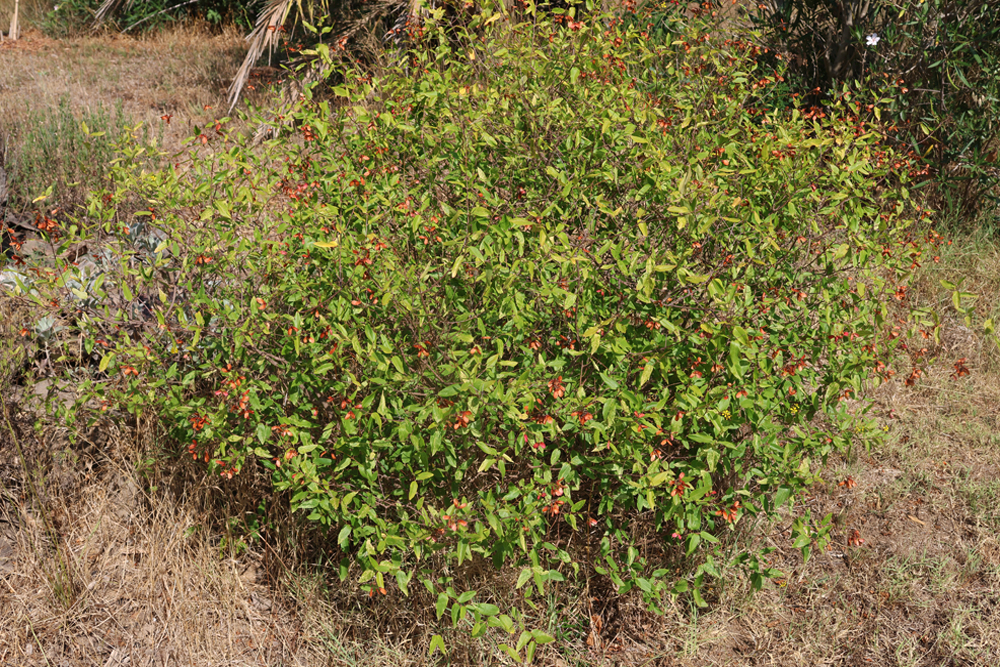
I have been growing this plant for about a dozen years without any trouble. I planted it one autumn, digging a hole five times the volume of the pot, added some organic matter, watered it intermittently for a year, and then more or less forgot about it, as watering the part of the garden where it is planted is not easy. It loses its foliage in summer, but does not hold it against me, and rewards me with a display of small, lemon-yellow flowers in spring, followed by bright, cheerful red fruits in early summer.
Je cultive cette plante depuis une douzaine d’années sans difficulté ; pour cela j’ai creusé en automne un trou de 5 fois le volume du pot, ai apporté de la matière organique, l’ai arrosé de façon intermittente pendant un an, puis l’ai plus ou moins oubliée car l’arrosage de la zone du jardin où elle se trouve n’est pas facile (il est peu abondant 3 fois par mois sec). Elle perd du feuillage l’été, mais ne m’en veut pas trop et me gratifie d’une floraison de petites fleurs jaune citron au printemps, suivi de fruits rouges bien visibles et gais en début d’été.
I had forgotten its name. I could not find it anywhere in my books on Mediterranean plants and dry gardens, which do not mention it, but managed to identify it again thanks to a forum where one of the French suppliers posts. Once the name was found, I could look up information about it online (see the Webography at the end of the article).
J’avais oublié son nom, impossible de le retrouver en consultant tous mes livres de plantes méditerranéennes et de jardin sec qui ne le mentionnent même pas, je l’ai re-identifié grâce à un forum où intervient un des fournisseurs français. Quand on connait son nom on peut cependant trouver quelques éléments sur internet (voir Webographie en fin d’article).
Heteropterys glabra originates from a region in northern Argentina where there are many plants suited to Mediterranean climates with mild winters. This region includes northern Argentina, Uruguay, Paraguay and southern Brazil. The plant is something of an exception as it is not very sensitive to frost.
Origine, c’est une zone au nord de l’Argentine où l’on trouve beaucoup de plantes intéressantes pour climat méditerranéens à hivers doux, elle comprend le nord de l’Argentine, Uruguay et Paraguay et le Sud du Brésil. Cette plante fait un peu exception : elle est peu sensible au gel.
Description
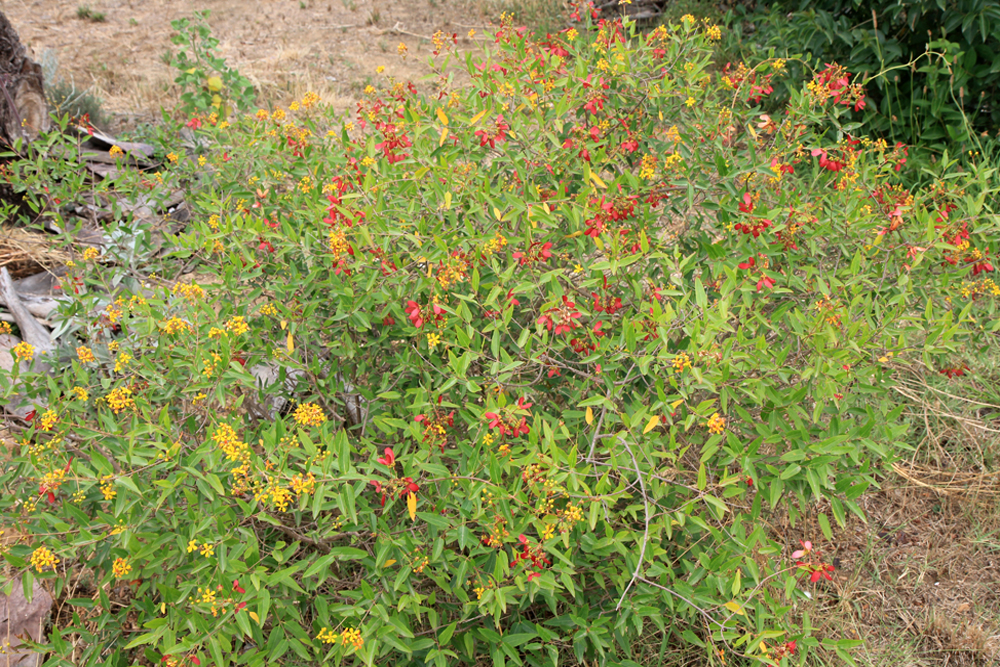
The extent of its growth depends on the amount of water it receives. My plant, which I have grown under harsh conditions, is a small, rounded shrub measuring just under a metre in all directions, but I have read that it can grow to around 1.50m and sometimes more. It can be somewhat climbing in nature, sending out long shoots that cling to surrounding vegetation or a wall.
Description
L’importance de son développement dépend de l’eau qui lui est fournie. Pour ma plante cultivée à la dure, il s’agit d’un petit buisson au port arrondi d’un petit mètre en tous sens, mais je lis qu’il peut faire environ 1,50m et parfois plus, être un peu volubile et envoyer de longs rameaux qui s’appuient sur la végétation environnante ou un mur.
The leaves are oval to lanceolate and a bright green. The flowers are small and lemon-yellow.It is the fruits that are the plant’s main attraction, so much so that both its botanical name (pterys = wing) and its common name, ‘redwing’, highlight the distinctive nature of its red fruits. The seeds grow in pairs, each with a red wing extending from it, much like the samaras of maple trees. These fruits are highly visible for around two months, before turning brown and drifting away. In my dry environment, I have never seen any self-sown seedlings.
Les feuilles sont ovales à lancéolées, bien vertes. Les fleurs sont petites jaune citron.Ce sont les fruits qui font l’essentiel de l’intérêt de la plante si bien que ses noms aussi bien botanique (pterys = aile) que vernaculaires ’redwing’ (aile rouge) retiennent le caractère essentiel des fruits rouges. Les graines sont groupées par deux et chacune prolongée d’une aile rouge comme les samares des érables. Ces fruits sont très visibles pendant environ 2 mois, puis brunissent et s’envolent. Dans mon environnement sec je n’ai jamais vu de semis spontané.
Cultivation
Under my conditions, growth is slow, more generous watering would speed up growth.
The plant tolerates heavy soils on clay subsoil provided they are well-drained, also alkaline soils, drought and cold down to at least -12°C. It can be grown in North Carolina parts of which are USDA zone 7B (to -15°C). It prefers light soil in full sun or partial shade and will thrive best if watered thoroughly three times a month during the summer.
Culture
Dans mes conditions la croissance est lente ; des arrosages plus copieux accélèreraient la pousse. Cette plante supporte les terrains lourds sur sous-sol argileux à condition d’être bien drainés, le calcaire, la sécheresse, le froid au moins jusqu’à -12°C, elle peut être cultivée en Caroline du nord voire jusqu’à la zone USDA 7B. Elle préfère un sol léger en plein soleil ou ma mi-ombre et sera plus belle en l’arrosant de façon profonde 3 fois par mois d’été.
Where to find it
Plants:
I only know of two suppliers: Dino Pellizarro and the Rochevieille nursery.
Seeds and seedlings:
I will harvest seeds and supply them to the MGF seed bank.
Semences du Puy currently has seeds in stock.
Sowing is said to be easy in autumn or early spring. I will try some myself in mid-September.
Où la trouver ?
Plants :
Je ne connais que 2 fournisseurs : Dino Pelizarro et pépinière de Rochevieille.
Graines et semis :
Cette année j’ai récolté les dernières graines et les ai fournies à notre banque de graines.
Semences du Puy la proposent parfois.
Le semis est dit facile en automne ou début du printemps.
If you grow this plant, please do share your experiences with us, as it is currently very rarely seen.
N’hésitez pas à nous faire part de vos expériences de culture de cette plante dont la diffusion est pour l’instant très restreinte.
Webography
A description by a North Carolina nursery, Plant Delights Nursery.
A video about the climbing form of the plant
Webographie
Description par pépinière de Caroline du Nord : Plant Delights Nursery
Texte et photos : Pierre Bianchi
