Visits to the jardin des plantes de Montpellier and a private garden
Visite du jardin des Plantes de Montpellier et un jardin privé
Click on the images to enlarge them / Cliquez sur les images pour les agrandir
Our visit to the Montpellier Botanical Garden was a great success, especially since it was a sunny day. Denis Nespoulous, our gardener/botanist guide, accompanied us along paths lined with centuries-old trees. The theme of the visit being ‘At the crossroads of history and ecology’, he described the major periods in the somewhat turbulent history of this garden.
Notre visite du jardin des Plantes de Montpellier a eu un beau succès, d’autant plus que la journée était ensoleillée. Denis Nespoulous, notre guide jardinier-botaniste du jardin nous a accompagnés tout au long des allées bordées d’arbres plus que centenaires. Le thème de la visite étant « Au carrefour de l’histoire et de l’écologie », il nous a relaté les grandes périodes de la vie un peu tourmentée de ce jardin.
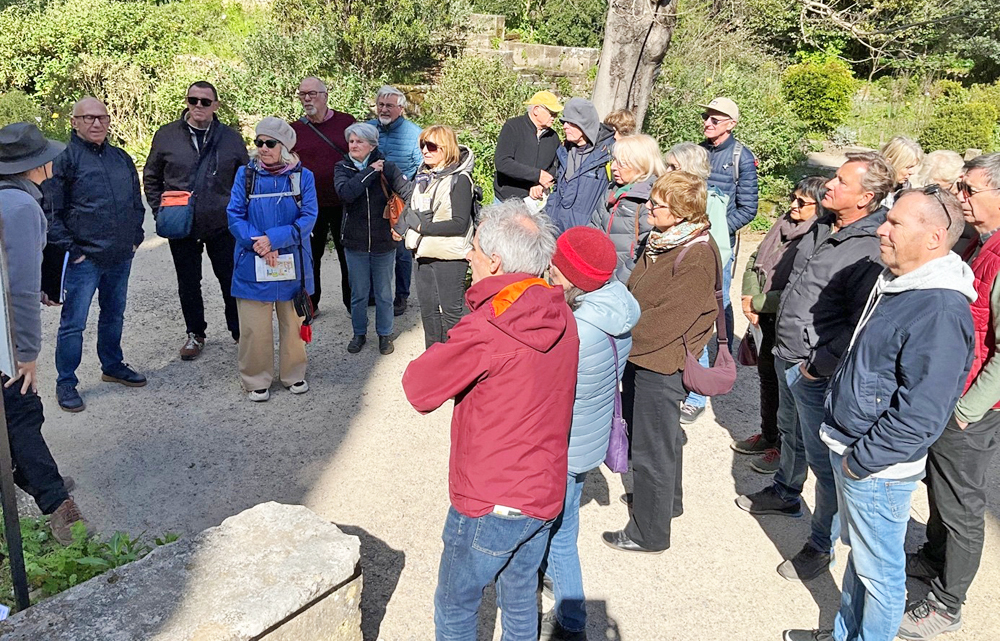
The Jardin des Plantes in Montpellier is the oldest botanical garden in France, founded in 1593 by Pierre Richer de Belleval, physician to King Henry IV. Its initial purpose was to teach medicinal plants to students of Montpellier’s renowned Faculty of Medicine, the oldest still in operation in the world (it recently celebrated its 800th anniversary). A heritage garden shaped by four centuries of history, this botanical landmark has evolved over time, influenced by the many scholars who have worked there, such as Pierre Magnol, the inventor of botanical families, and Auguste-Pyramus de Candolle, the father of taxonomy, who established his forestry school among the trees that are now centuries old. The great Linnaeus himself named many species thanks to the collections of Montpellier’s botanical school (in homage to which, he dedicated several plants to the city). Richer de Belleval, for his part, with his flora of Languedoc, is considered a pioneer of modern botany. On the terraces of his ‘Mountain’, an artificial mound adjoining those of the first medical garden, he set out the plants he knew and loved according to a highly innovative design: by habitat (shade-loving or sun-loving plants, rocky or humid environments, etc.), making him, two and a half centuries ahead of his time, an ecological pioneer.
Le Jardin des Plantes de Montpellier est le plus ancien jardin botanique de France, fondé en 1593 par Pierre Richer de Belleval, médecin du roi Henri IV. Sa première vocation fut l’enseignement des plantes médicinales à destination des étudiants de la célèbre faculté de médecine de Montpellier, la plus ancienne en exercice au monde (elle vient de fêter ses 800 ans). Jardin patrimonial que quatre siècles d’histoire ont façonné, ce haut-lieu de la botanique a su évoluer, au fil du temps et des nombreux savants qui s’y sont succédé, tel Pierre Magnol, l’inventeur des familles botaniques, ou Auguste-Pyramus De Candolle, le père de la taxonomie, qui installa son école forestière aux arbres aujourd’hui séculaires. Le grand Linné lui-même nomma beaucoup d’espèces grâce aux récoltes de l’école de botanique de Montpellier (en hommage à laquelle il dédicaça plusieurs plantes à la ville). Richer de Belleval, quant à lui, avec sa flore du Languedoc, est considéré comme un pionnier de la botanique moderne. Mieux encore, sur les banquettes surélevées de sa Montagne, tertre artificiel qui jouxtait celles du premier Jardin médical, il avait installé les plantes qu’il connaissait et qu’il aimait selon un design très novateur : par milieux de vie (plantes d’ombre ou de plein soleil, de milieu rocheux ou de milieu humide…), ce qui fait de lui, avec deux siècles et demi d’avance sur son temps, un précurseur de l’écologie.
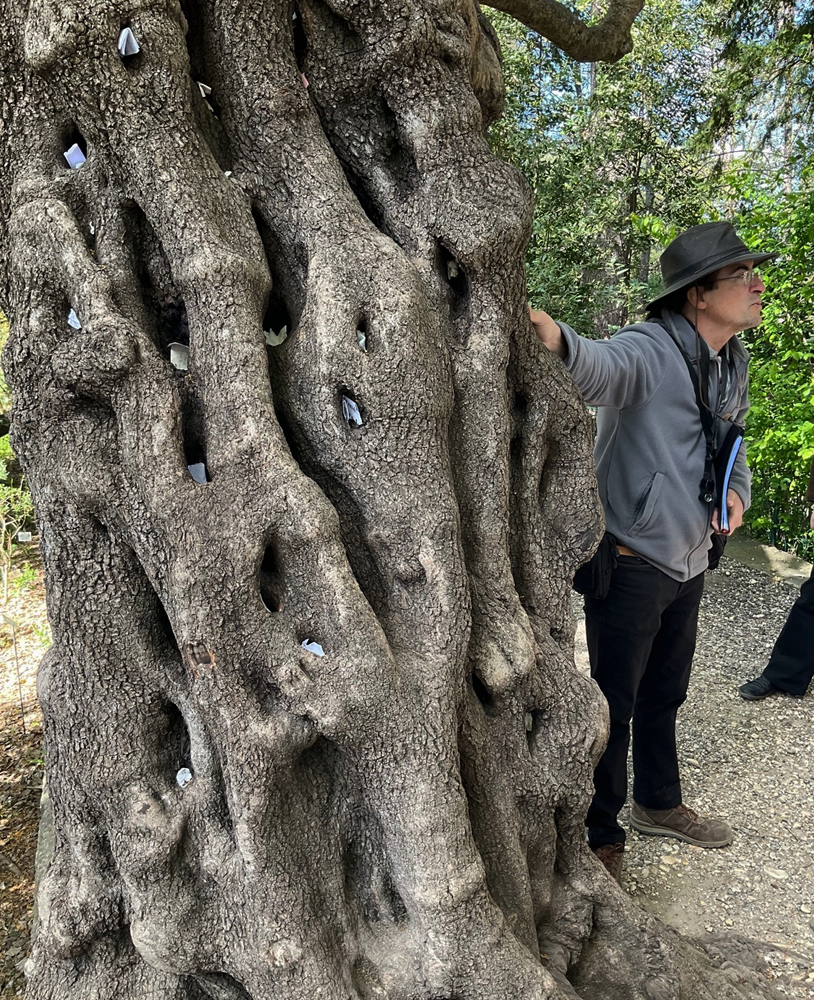
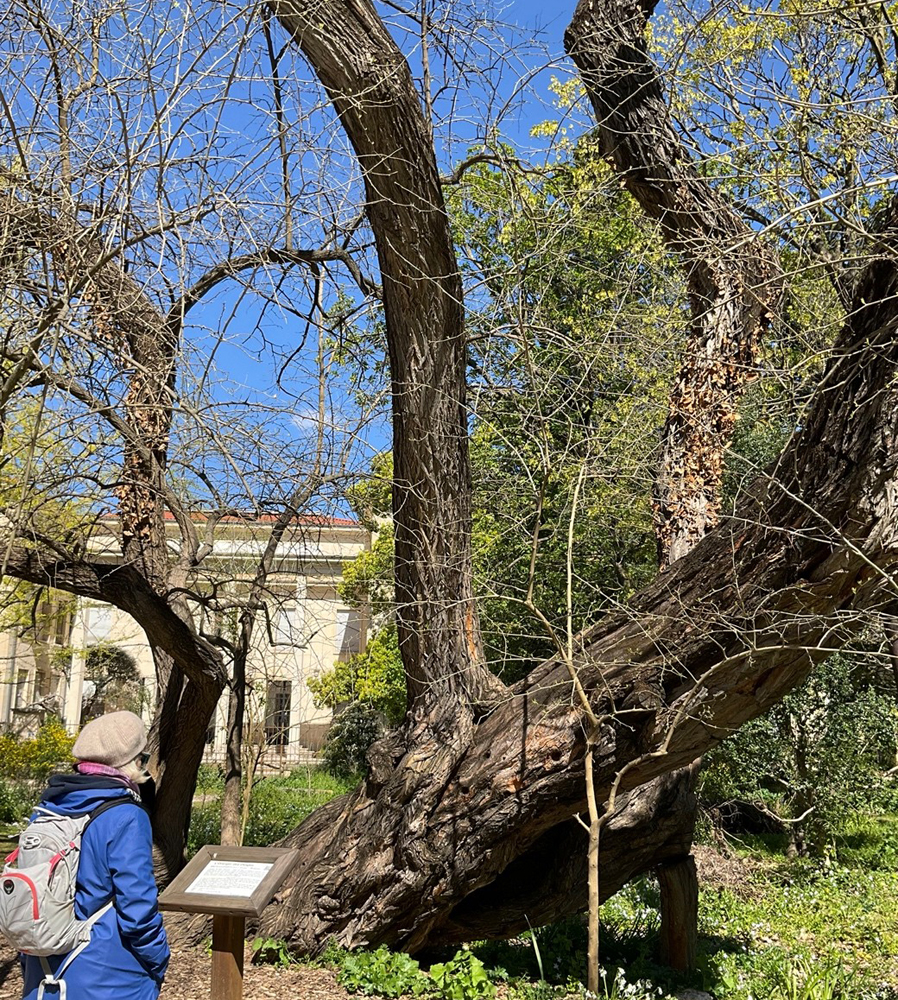
During our walk, we saw an unusual monument dedicated to François Rabelais, the illustrious writer who wrote ‘La Morale Comédie’ in Montpellier, after having been a student at the Faculty of Medicine. Then, climbing the Richer Mountain, its terraces planted with Mediterranean shrubs, we came across the message tree. This is a broad-leaved phillyrea, (Phillyrea latifolia) whose trunk has been hollowed out with geodes (holes). It has long served as a ‘lovers’ mailbox’ and has now become a ‘wishing tree’. It measures approximately 10 metres and is one of the most famous trees in France.
Tout au long de notre ballade, nous verrons l’insolite monument dédié à François Rabelais, illustre écrivain, qui écrivit son ouvrage « la Morale Comédie » à Montpellier, après avoir été étudiant à la Faculté de Médecine. Puis en escaladant la Montagne de Richer, garnie de terrasses et plantée d’arbustes méditerranéens, nous avons rencontré l’arbre à messages. C’est un filaire à feuilles larges dont le tronc est creusé de géodes (trous) et qui a longtemps servi de « boîte à lettres aux amoureux ». Il est devenu un « arbre à souhaits ». Il mesure environ 10 mètres et fait partie des arbres les plus célèbres de France.
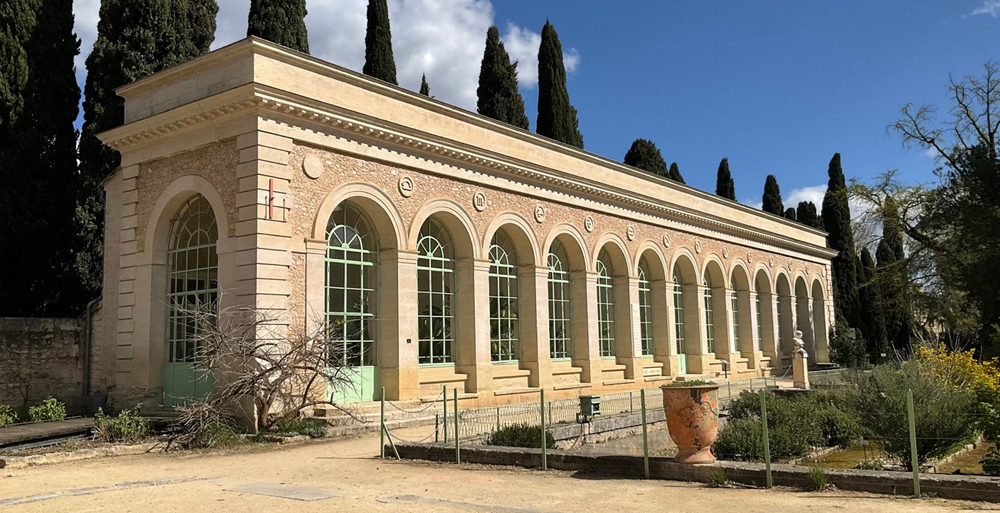
Next, we admired the architecture of the Orangerie, completed in 1806 and bearing the symbols of the twelve months of the French revolutionary calendar. It houses citrus trees and cycads during the colder season.
Nous pourrons ensuite admirer l’architecture de l’Orangerie, achevée en 1806 et portant les symboles des douze mois du calendrier révolutionnaire français. Elle abrite à la saison froide agrumes et Cycadales.
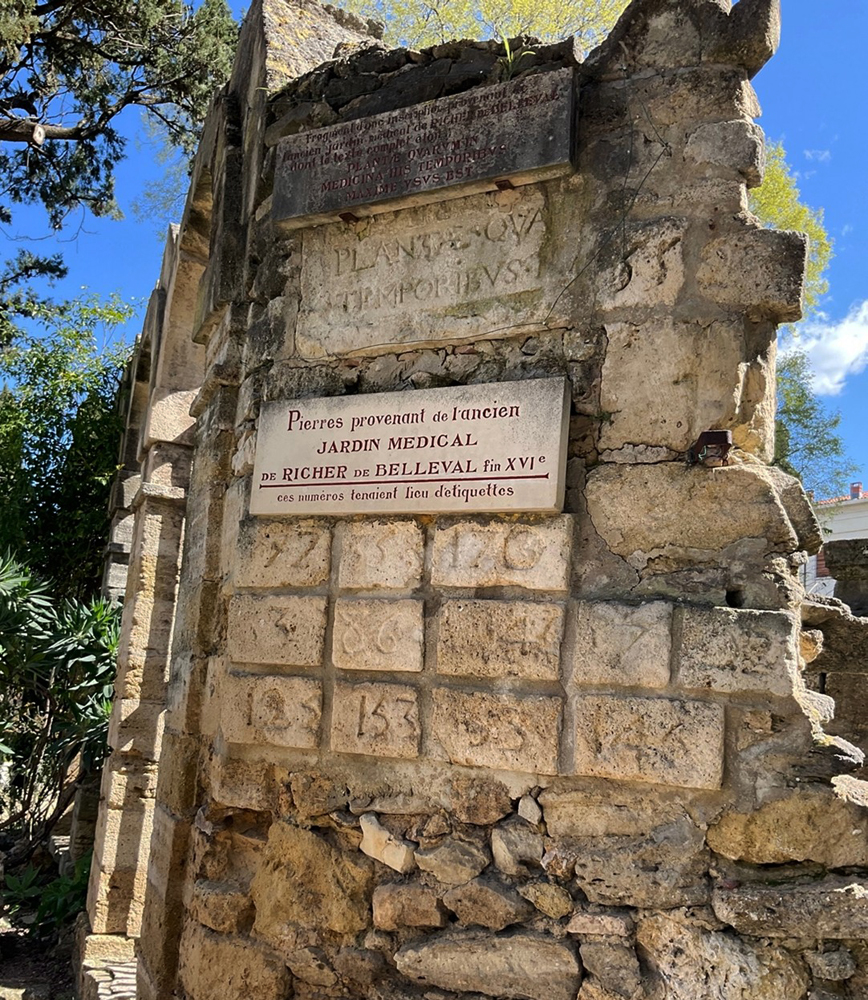
Then we headed towards the old waterwheel, surrounded by fake ruins and into which the engraved stones of Richer de Belleval had been incorporated. They were used to identify the plants on the slopes of the mountain.
Puis nous nous sommes dirigés vers l’ancienne noria, entourée de fausses ruines et sur lesquelles on y a incorporé les pierres gravées de Richer de Belleval. Elles servaient à identifier les plantes des banquettes de la Montagne.
As we descend, we discover a discreet monument with an air of mystery, the ‘Tomb of Narcissa’. Legend has it that Edward Young, English poet and author of Night-Thoughts, secretly buried his stepdaughter there after she died of tuberculosis in 1736.
En descendant, on va découvrir un monument discret au parfum de mystère, le « tombeau de Narcissa ». La légende dit qu’Edward Young, poète anglais et auteur des Nuits, y aurait inhumé en secret sa belle-fille morte de la tuberculose une nuit de 1736.
Among the most remarkable trees we saw:
- Maclura pomifera, the Osage orange, native to the southern USA. Native Americans (the Osage tribe) used it for its wood and sap. The one in the garden is so heavy that the branches skim the ground. Its fruit resemble large, greenish oranges.
- Ginkgo biloba Ginkgo means silver apricot in Japanese, referring to the false fruits, which botanists compare to eggs.
- Carya illinoensis, the Illinois pecan tree. The one in the garden was planted in 1830 and is now almost 30 meters tall.
Parmi les arbres les plus remarquables, citons
- L’Oranger des Osages ou Maclura pomifera, originaire du sud des États-Unis. Les Indiens (tribu des Osages) l’utilisaient pour son bois et sa sève. Celui du jardin est tellement lourd qu’il se couche et ses fruits ressemblent à de grosses oranges verdâtres.
- Le Gingko biloba : Gingko signifie abricot argenté en japonais pour qualifier ses faux fruits que les botanistes comparent à des œufs.
- Le pacanier de l’Illinois ou Carya illinoensis : celui du jardin a été planté en 1830 et atteint aujourd’hui presque 30 mètres de haut.
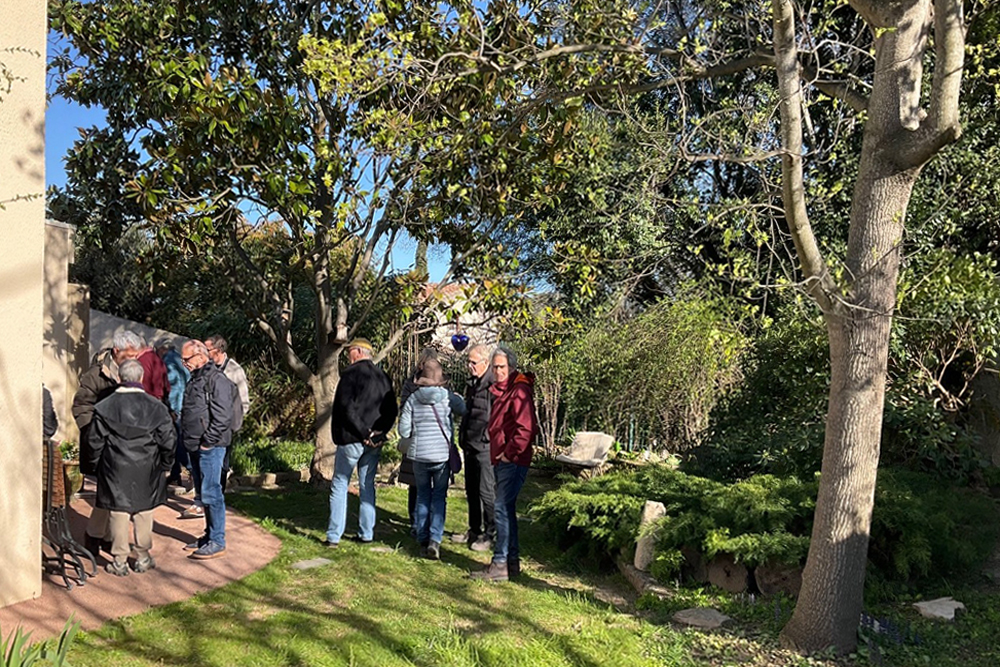
After a thoroughly enjoyable lunch, we visited Marianne’s garden in Cournonterral, a small, exquisitely crafted jewel.
Après un déjeuner fort apprécié, nous avons visité un jardin privé à Cournonterral. Le jardin de Marianne est comme un petit bijou savamment ciselé.
On entering, one is enveloped by the spirit of Normandy. Stepping into the cool shade of the tall trees and the lawn there are tulip trees (Liriodendron tulipifera), Schinus molle, birch, cotinus, liquidambar, loquat, hazel trees and more.
Dès qu’on entre, l’esprit normand nous touche, nous pénétrons dans la fraicheur des grands arbres et de la pelouse : tulipier de Virginie, Schinus molle, bouleau, Cotinus, liquidambar, néflier du japon, noisetiers, etc.
Beneath the Magnolia grandiflora, you can see a meadow of liriope (an excellent plant for dry shade), nandina, and horsetail, an indicator of deep-rooted moisture.
Sous le Magnolia grandiflora nous pouvons voir une prairie de liriopes (excellente plante d’ombre sèche), des nandinas et de la prêle, indicateur d’une certaine humidité en profondeur.
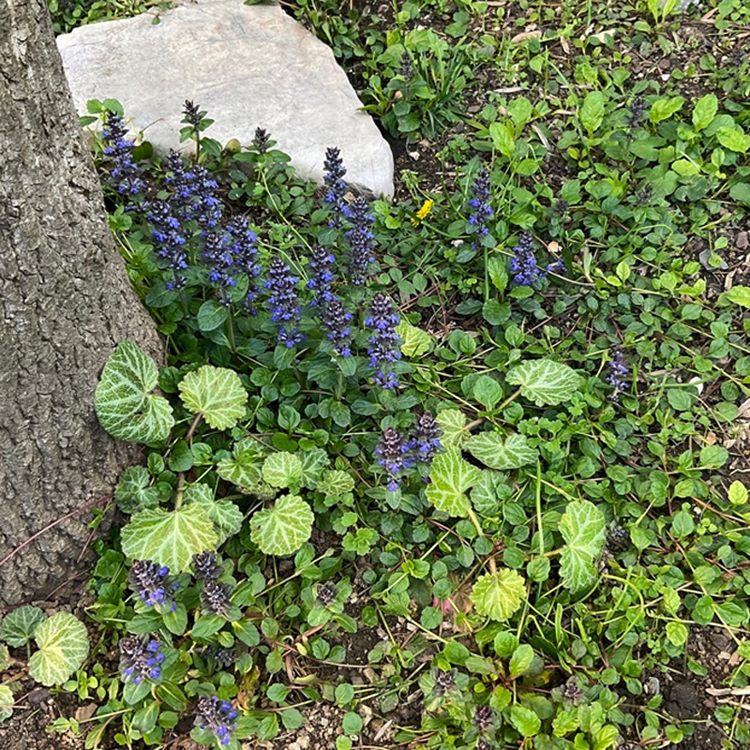
In the small pond surrounded by aquatic plants, goldfish hide under the myriophyllum (water milfoil). The edges of the flowerbeds are beginning to gently blend into the lawn with ground cover plants such as Ajuga reptans, Geranium macrorrhizum, and bergenias.
Dans le petit bassin entouré de plantes aquatiques, les poissons rouges se cachent sous les myriophylles. Les contours des massifs commencent à gagner doucement la pelouse avec les plantes tapissantes comme l’Ajuga reptans, le Geranium macrorrhizum ou les bergenias.
Here and there are islands of aromatic plants, irises, phormiums and miscanthus. And look! A foreigner – a westringia, the Australian rosemary!
Par-ci, par-là, des ilots d’aromatiques, d’iris, de phormiums et miscanthus. Ah tiens ! une étrangère : un westringia ou romarin d’Australie !
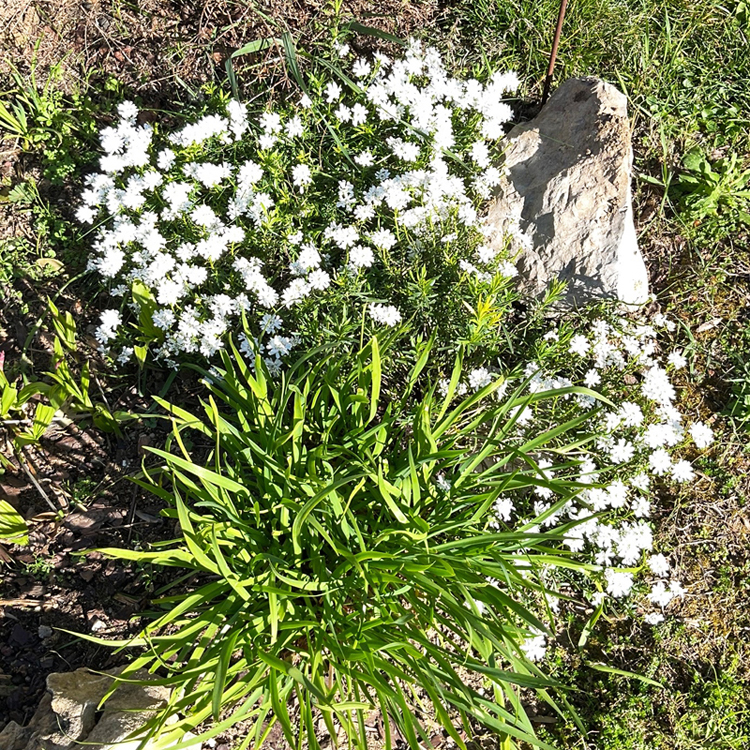
We left the front garden and headed towards the back (a bit like in a London suburb) via steps lined with plumbago and Podranea ricasoliana (Algerian trumpet vine) which will be at their peak in late summer. At the bottom of the steps, a shady area shelters two maples, a tree peony, a myrtle, and two Hydrangeas: H. quercifolia, a magnificent hydrangea that thrives in our Mediterranean climate, and H. serrata, which may not survive prolonged drought.
Nous quittons le jardin de devant pour nous diriger vers le jardin arrière (un peu comme dans une banlieue de Londres) par l’escalier bordé du plumbago et du Podranea (bignone d’Alger) qui seront à leur apogée en fin d’été. En bas de l’escalier une partie ombragée qui abrite 2 érables, une pivoine arbustive, un myrte, et deux hortensias : quercifolia (magnifique hortensia qui s’adapte à merveille sous notre climat méditerranéen) et serrata (surement plus fragile chez nous).
Near the pool, we find a superb Grevillea johnsonii, Pittosporum tobira, Arbutus unedo and a Punica granatum (pomegranate). Yes, we have definitely left Normandy and are now in the heart of the Mediterranean. The pergola offers a beautiful trio of Clematis armandii, Trachelospermum jasminoides and Campsis radicans.
Près de la piscine, nous trouvons un superbe Grevillea johnsonii, Pittosporum tobira, arbousier et grenadier. Oui, nous avons bien quitté la Normandie et sommes en plein midi méditerranéen. La tonnelle nous offre un beau trio avec Clematis armandii, Trachelospermum et bignone.
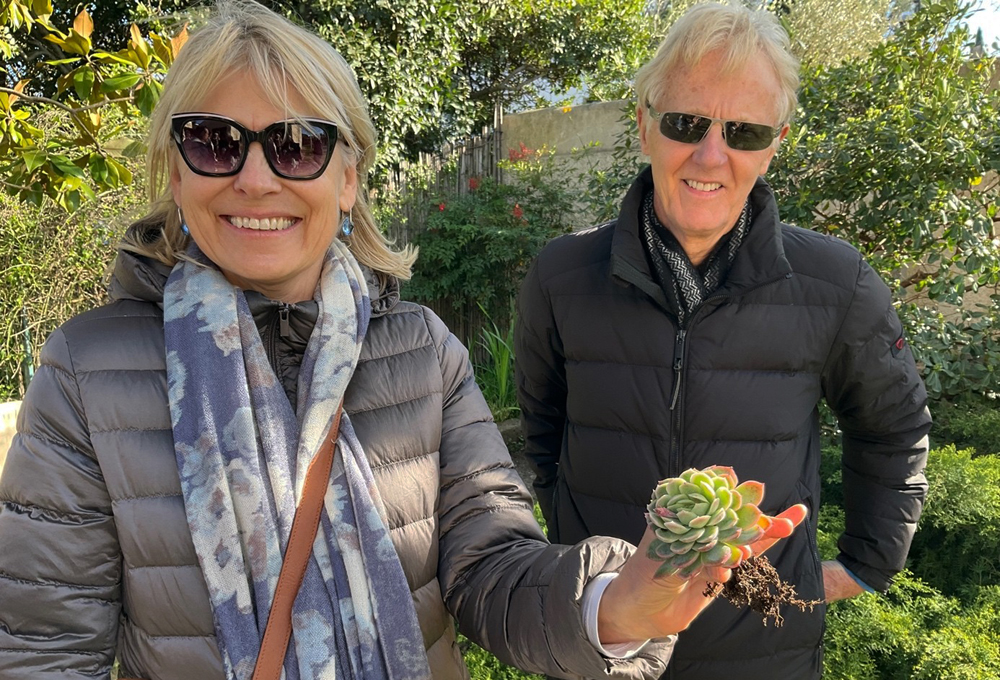
Next come the apricot and cherry trees, basking in the sun, so that their fruit, destined for jam, will ripen to perfection. To protect the trees from the sun’s heat, Marianne places cardboard boxes around the trunks so that the trees will retain the moisture necessary for fruiting. Near the Juniperus horizontalis, a Lobelia laxiflora, another excellent drought-tolerant plant that blooms for six consecutive months from spring to autumn, enjoys the shade of the rosebush and jujubier. Our visit ended with a look at the succulent garden.
Viennent ensuite l’abricotier et le cerisier qui se prélassent tout en murissant à point leurs fruits destinés aux confitures. Pour protéger ces arbres du soleil ardent, Marianne dispose tout autour du tronc quelques cartons, ils garderont l’humidité nécessaire à la fructification.
Près du Juniperus horizontalis, le Lobelia laxiflora (encore une bonne plante supportant la sécheresse et fleurissant 6 mois d’affilée du printemps à l’automne) profite de l’ombre du rosier et du jujubier. Viendra finalement la visite des succulentes et plantes grasses.
But the visit was not over, because Marianne had prepared tea for us with biscuits and, above all, as we say in French, the cherry on top, some cuttings as a parting gift! Thank you Marianne.
Nous n’en terminerons pas là, car Marianne nous avait préparé un thé accompagné de biscuits et surtout, comme on dit en français : la cerise sur le gâteau : quelques boutures en cadeau d’adieu ! Merci Marianne.
Texte et photos: Chantal Guiraud
